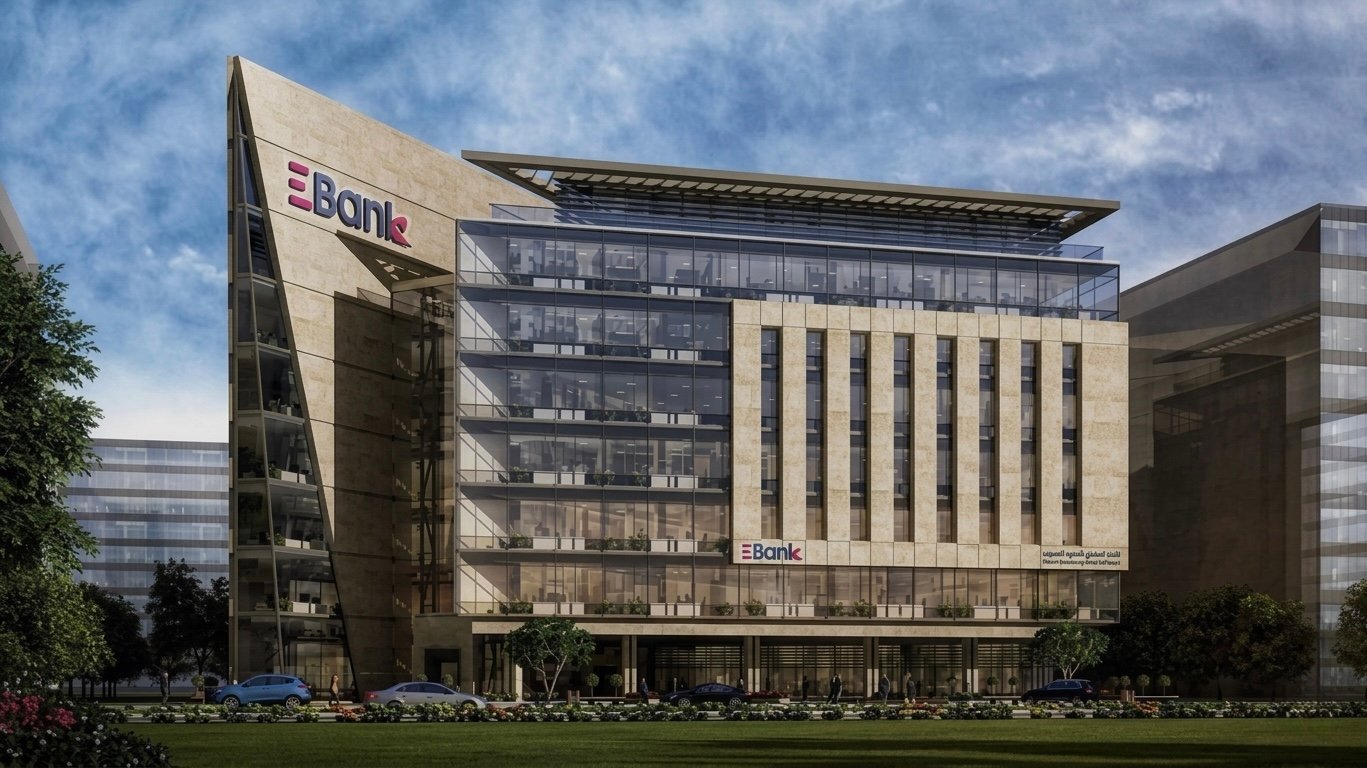
Atlantis Contracting successfully completed the supply and installation of advanced firestop systems and fire-rated cladding joint solutions for the EBank Headquarters in Egypt’s New Administrative Capital. The project integrated Metacaulk® passive fire protection products with engineered fire-rated cladding joint systems to maintain fire compartmentation, enhance smoke and fire containment, and ensure compliance with international fire safety standards.
Atlantis Contracting successfully completed the supply and installation of advanced firestop systems and fire-rated cladding joint solutions for the EBank Headquarters in Egypt's New Administrative Capital — executed for Archirodon Egypt in 2021. The scope encompassed a comprehensive range of Metacaulk® passive fire protection products applied across MEP penetrations throughout the building, combined with engineered fire-rated cladding joint systems at façade movement joints and perimeter interfaces. The works preserved fire compartmentation integrity, ensured smoke and fire containment across all penetration types and façade interfaces, and delivered full compliance with the project's fire safety requirements and international passive fire protection standards.
Project Overview
EBank Headquarters — New Administrative Capital
Client:Archirodon Egypt
Location:New Administrative Capital, Cairo, Egypt
Contractor:Atlantis Contracting
Scope:Firestop Systems for MEP Penetrations & Fire-Rated Cladding Joint Solutions
Main Systems:Metacaulk® 1200 Mastic | Metacaulk® 1000 Sealant | Metacaulk® MC 150+ | Metacaulk® Wrap Strip | Fire-Rated Cladding Joint Systems
Standards:International Passive Fire Protection Standards | Approved Tested Systems
Site Conditions Upon Arrival
Upon mobilization to the EBank Headquarters site, the Atlantis team conducted a comprehensive audit of all MEP penetrations and façade cladding joint locations. The following conditions were documented:
•A large number of MEP penetrations through fire-rated walls and floors had been installed by other trades without any firestop treatment — presenting immediate fire compartmentation and smoke spread risks across the building.
•Penetrations contained highly varied service types — cable trays, electrical conduits, cable bundles, metallic pipes, plastic pipes, and insulated piping — each requiring a different Metacaulk® system detail and product selection.
•Façade cladding joint interfaces and perimeter gaps at floor-slab-to-cladding transitions were open and untreated, creating potential paths for fire and smoke to spread between compartments via the building envelope.
•Substrate conditions at penetration locations varied — some walls and floors required surface cleaning and minor repair before firestop products could be applied.
•Building was at an advanced fit-out stage with MEP, joinery, and finishing trades active across multiple floors simultaneously, requiring precise access coordination and protection of completed works.
Site Challenges & Atlantis Solutions
Challenge 1: Diverse MEP Penetration Types Requiring Multi-Product System Selection
The EBank Headquarters MEP penetration scope involved an extensive variety of service types passing through fire-rated assemblies — cable trays, conduits, single and bundled cables, metallic pipes, plastic pipes, and insulated services. Each service type required a specific Metacaulk® product and installation detail to achieve the required fire resistance rating, making standardized single-product application impossible.
Solution: Atlantis conducted a full penetration classification audit prior to commencement — categorizing every penetration by service type, substrate, annular space, and required fire rating. A system selection matrix was prepared, mapping each penetration category to the correct Metacaulk® product: Metacaulk® 1000 for standard cable and pipe penetrations; Metacaulk® 1200 mastic for large and complex openings; MC 150+ for linear joints and mixed services; and Wrap Strips for combustible and insulated pipe penetrations. This structured approach ensured every penetration received the correct, tested, and approved system.
Challenge 2: Fire-Rated Cladding Joint Treatment at Façade Interfaces
Façade perimeter gaps and cladding movement joints at the floor-slab-to-cladding interface presented a technically specialized challenge — these locations are the most common path for fire and smoke to travel between floors via the building envelope (known as 'curtain wall bypass'). Treatment required engineered fire-rated joint systems capable of accommodating façade thermal movement while maintaining continuous fire and smoke barrier performance.
Solution: Atlantis installed purpose-designed fire-rated cladding joint systems at all façade perimeter interfaces and movement joints. The systems were selected to accommodate the thermal and structural movement of the cladding envelope while providing a continuous, tested fire and smoke barrier. Installation was coordinated with the façade and cladding contractor to ensure correct positioning, compression, and sealing at every floor level.
Challenge 3: Large & Complex Openings Requiring Metacaulk® 1200 Mastic
A number of MEP penetration openings at the EBank site were oversized — containing multiple mixed services, irregular shapes, or large annular spaces — that could not be effectively sealed using standard sealant or wrap products alone. These openings required a sprayable and brushable firestop coating solution.
Solution: Metacaulk® 1200 firestop mastic was selected and applied for all large and complex openings. The material's sprayable and brushable properties allowed full coverage of irregular void geometries and multi-service configurations that rigid or cartridge-based products could not effectively address. All applications were carried out to the manufacturer's approved thickness requirements and independently inspected before sign-off.
Challenge 4: Protection of Completed Works in Active Fit-Out Environment
The EBank Headquarters was at an advanced fit-out stage during firestop works execution — with joinery, MEP, and finishing contractors actively working across the same floors. Completed firestop installations were at risk of damage, contamination, or inadvertent removal by other trades working in the same penetration zones.
Solution: All completed firestop installations were labelled in accordance with project requirements and photographically documented with penetration reference numbers immediately upon completion. Temporary protection was applied where other trades were active in adjacent zones. A final re-inspection programme was implemented before handover to identify and reinstate any installations that had been disturbed during the fit-out phase.
Firestop Systems Applied
Product
Application
Type
Metacaulk® 1200
Large & complex wall/floor openings — sprayable & brushable firestop coating
Firestop Mastic
Metacaulk® 1000
Cables, conduits, metallic pipes, mixed-service penetrations
Intumescent Sealant
Metacaulk® MC 150+
Linear joints, service penetrations, acoustic & smoke sealing
General-Purpose Sealant
Metacaulk® Wrap Strip
Combustible & insulated pipe penetrations — intumescent wrap
Wrap System
Fire-Rated Cladding Joint System
Façade movement joints & floor-slab-to-cladding perimeter interfaces
Engineered Joint System
Operations Summary
The following sequence of operations was carried out by the Atlantis team:
•Site mobilization and comprehensive penetration audit — classifying all MEP penetrations by service type, substrate, annular space, and required fire rating across all floors.
•Preparation of penetration system selection matrix mapping each penetration category to the correct Metacaulk® product and installation detail.
•Substrate preparation at all penetration locations — surface cleaning, minor repair, and priming as required.
•Application of Metacaulk® 1000 intumescent sealant to cable, conduit, and metallic pipe penetrations through fire-rated walls and floors.
•Application of Metacaulk® 1200 firestop mastic to all large, complex, and irregular-shaped wall and floor openings.
•Application of Metacaulk® MC 150+ sealant to linear joints, mixed-service penetrations, and acoustic and smoke sealing applications.
•Installation of Metacaulk® Firestop Wrap Strips around all combustible and insulated pipe penetrations.
•Supply and installation of fire-rated cladding joint systems at all façade movement joints and floor-slab-to-cladding perimeter interfaces.
•Labelling and photographic documentation of every completed penetration with penetration reference number.
•Final re-inspection across all floors — identification and reinstatement of any installations disturbed during fit-out phase.
•Handover documentation, inspection reports, and quality sign-off submitted to Archirodon Egypt.
Outcome & Performance
Upon completion, Atlantis Contracting delivered a comprehensive passive fire protection solution for the EBank Headquarters — covering both internal MEP penetrations and external façade cladding interfaces throughout the building. The integrated application of Metacaulk® firestop technologies and fire-rated cladding joint systems ensured effective fire compartmentation, smoke control, façade fire integrity, and full compliance with the project's international passive fire protection standards. The project contributes to the long-term resilience, operational reliability, and life-safety performance of one of the landmark developments in Egypt's New Administrative Capital, and stands as a strong reference for Atlantis's specialist firestop capability in high-specification commercial and institutional projects.
Gallery
Topics