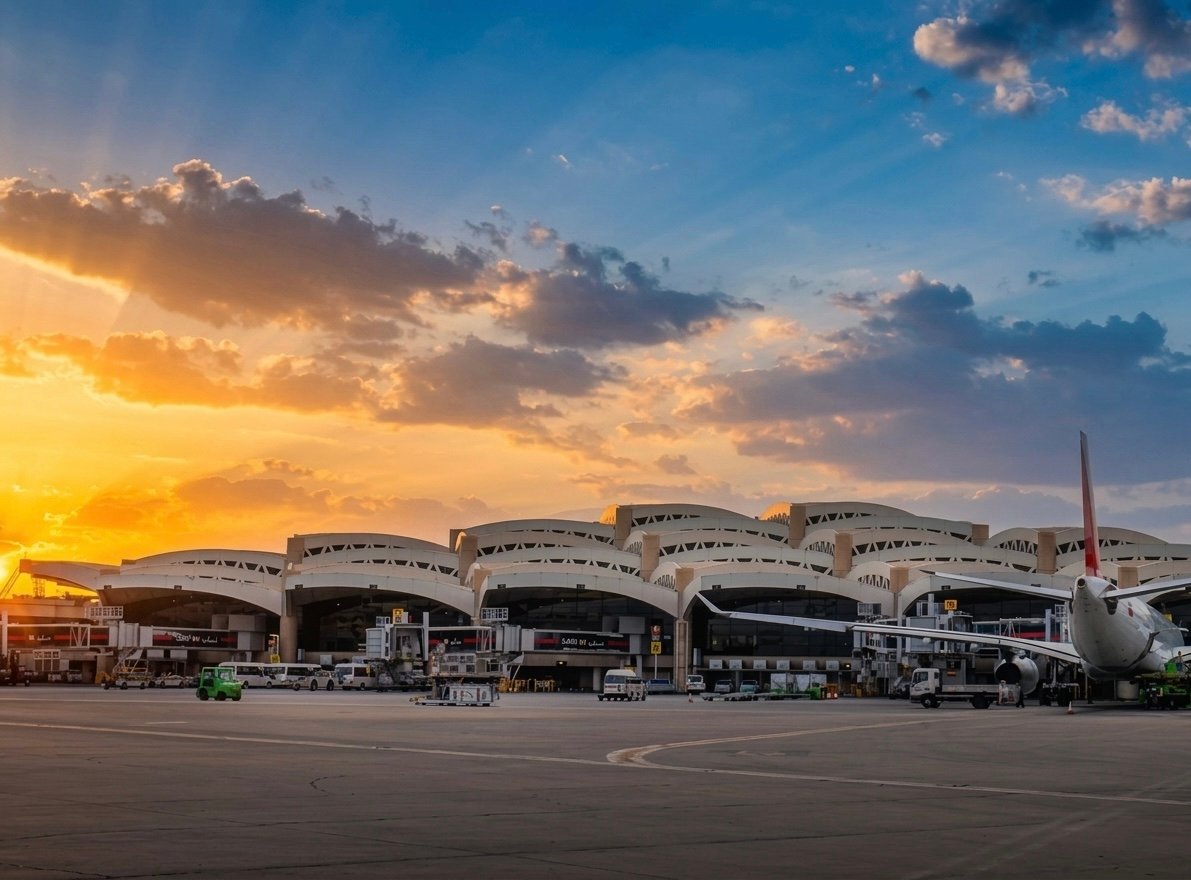
Atlantis Contracting completed the replacement of the bridge expansion joint system at King Khalid International Airport (KKIA) using the BEJS precompressed silicone-and-foam expansion joint system integrated with Wbocrete II crystalline waterproofing, delivering a durable, watertight solution designed for long-term structural performance.
Atlantis Contracting was engaged to carry out the full supply and installation of a bridge expansion joint system at King Khalid International Airport (KKIA) in Riyadh. The scope covered the complete removal of the existing failed expansion joint system and its replacement with a fully watertight, high-durability solution comprising the BEJS precompressed silicone-and-foam expansion joint system (Sika Emseal) combined with Wbocrete II crystalline waterproofing treatment applied to both sides of each joint — engineered to prevent water ingress and ensure long-term structural performance across a total installed length of 300 linear meters, at a contract value of SAR 1,000,000.
Project Overview
Bridge Expansion Joint Supply & Installation — KKIA.
Client / Location: King Khalid International Airport (KKIA), Riyadh.
Contractor:Atlantis Contracting.
Scope:Removal of failed expansion joints & installation of fully watertight system.
Total Quantity:300 Linear Meters (LM).
System Applied:BEJS (Sika Emseal) & Wbocrete II Crystalline Waterproofing.
Site Conditions Upon Arrival
Upon mobilization to site, the Atlantis team conducted a full condition survey of all expansion joints. The following conditions were documented:
•Existing expansion joints were severely deteriorated — the original sealing system had completely failed, exhibiting full-depth cracks, missing sealant segments, and open voids.
•Active water leakage was observed in multiple locations, with evidence of long-term water ingress causing staining, concrete spalling, and surface degradation at joint edges.
•Concrete nosing and joint edges showed significant damage — chipping, delamination, and loss of section — requiring repair prior to installation of the new system.
•Embedded steel angles in several joints were corroded and structurally compromised.
•Joint widths were inconsistent due to years of uncontrolled movement and material loss, requiring re-sizing assessment before material procurement could be finalized.
Site Challenges & Atlantis Solutions
Challenge 1: Severely Damaged Joint Edges
The existing concrete nosing at multiple joint locations had completely deteriorated — with large sections of spalled concrete, exposed rebar, and delaminated surfaces that could not support proper adhesion of the new system.
Solution: The Atlantis team executed full concrete repair operations prior to installation. Damaged sections were saw-cut, removed, and rebuilt using high-strength repair mortar to restore joint geometry and edge integrity. Surface preparation was carried out to the required substrate standard to ensure full bond with the epoxy adhesive.
Challenge 2: Inconsistent Joint Widths
Field measurements revealed that joint widths varied significantly from the original design dimensions due to years of uncontrolled thermal movement and material loss. This required re-selection of BEJS material sizes for multiple zones to match actual site conditions.
Solution: The Atlantis team conducted a comprehensive joint-by-joint survey and re-mapped all dimensions. Material orders were revised accordingly and zone-specific installation plans were prepared to ensure the correct nominal size was applied in each location, maintaining the required ±60% movement capability throughout.
Challenge 3: Active Water Leakage During Works
Several joint locations exhibited active water seepage during the removal and preparation phases, which threatened to compromise substrate preparation quality and epoxy adhesive bonding.
Solution: Temporary water control measures were applied at affected locations prior to substrate preparation. The team used moisture-tolerant epoxy adhesive as specified in the BEJS system, and scheduling was adjusted to allow adequate substrate drying time before proceeding with material installation.
Challenge 4: Airport Operational Constraints
Works were carried out within an active airport environment (KKIA), imposing strict access windows, traffic management requirements, noise restrictions, and material delivery limitations.
Solution: Atlantis coordinated closely with airport operations management to schedule all works within approved access windows. Works were phased to minimize disruption, with sectional closures planned and executed methodically. All materials and equipment were pre-staged to maximize productivity within each permitted working window.
Operations Summary
The following sequence of operations was carried out by the Atlantis team:
•Site mobilization, condition survey, and joint-by-joint dimensional mapping.
•Saw-cutting and mechanical removal of all failed existing expansion joint material.
•Concrete repair and nosing reinstatement at damaged joint edges using high-strength repair mortar.
•Surface preparation and substrate profiling to achieve bond-ready condition per BEJS system requirements.
•Application of moisture-tolerant, two-component epoxy adhesive to both joint faces.
•Application of Wbocrete II crystalline waterproofing treatment to both sides of each joint face prior to BEJS installation, forming a permanent chemical barrier against water ingress.
•Supply and installation of BEJS precompressed silicone-and-foam hybrid expansion joint system (Sika Emseal) across 300 LM.
•Field injection of silicone sealant bands along both sides of installed BEJS material.
•Installation of factory-fabricated corner transitions and termination pieces at changes in plane and direction.
•Final inspection, quality check, and watertightness verification across all installed sections.
Outcome & Performance
Upon completion, the combined system — BEJS (Sika Emseal) expansion joints with Wbocrete II crystalline waterproofing applied to both sides of each joint — was successfully installed across all 300 linear meters. The dual-system approach delivers full watertightness, ±60% total movement capability, and long-term structural durability suited to the operational demands of King Khalid International Airport. All works were completed within the approved access schedule without disruption to airport operations.
Gallery
Topics